
Reason
The agent handles a new request, chooses tools, resolves exceptions, and verifies the result.
Applied systems research · San Francisco
LLM agents discover how to complete a task one decision at a time. Applied Runtime turns the procedures they have already figured out into secure graph runtimes, behind one pipeline that works with the harness and tools you choose.
Read the thesis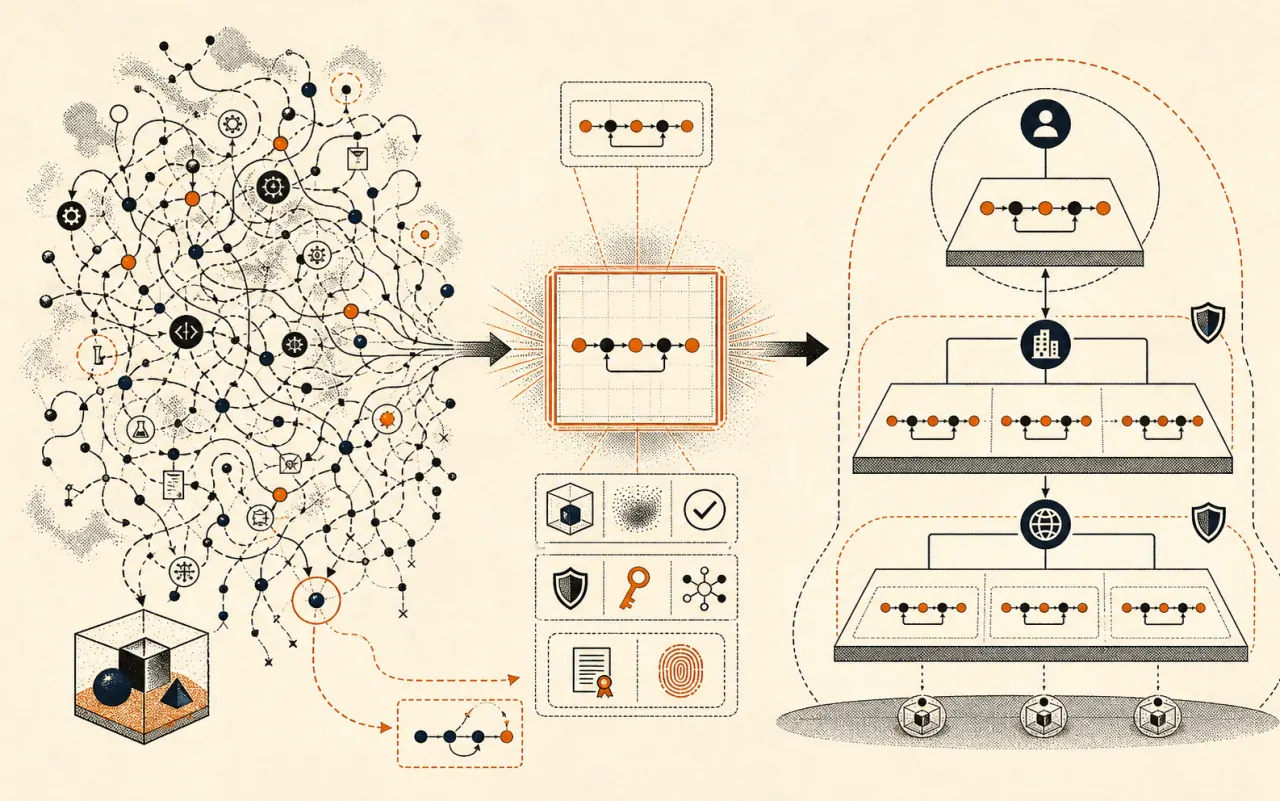
An agent interprets the request, decides what to do next, selects tools, transforms data, checks intermediate results, and recovers when something fails. For new and ambiguous work, this flexibility is valuable.
The waste begins after the procedure is known. Most production agents still reconstruct every step for every user, spending tokens and time to rediscover a path that already exists in prior traces.
We treat a successful trace as a candidate program. Stable work is compiled into a graph. Novel work stays agentic. One pipeline chooses the right execution path for each request.
The agent handles a new request, chooses tools, resolves exceptions, and verifies the result.
The trace records the decisions, tool contracts, data dependencies, checks, and recovery paths that worked.
Repeated traces reveal a stable task with explicit inputs, outputs, permissions, and failure conditions.
The proven procedure becomes a typed graph runtime with tests, versioning, and safe fallback behavior.
Known work executes directly. New or uncertain work returns to the agent through the same pipeline.
One agent pipeline chooses the right model and execution path for each request, learns from real use, and makes proven work cheaper and more reliable over time.
Choose the agent harness you already trust. Connect its tools, CLIs, and skills from a GitHub repository, or start with ours.
Each user query is routed to the model best suited to the task, balancing capability, speed, and cost.
Run across major sandbox providers through one consistent execution layer without rebuilding the agent loop for every environment.
When a process repeats reliably, it becomes a typed, permissioned graph workflow instead of another full LLM reasoning pass.
We automatically evaluate agent outcomes, find performance gaps, and create or revise the tools, skills, and workflows needed to close them.
Where exactly should a reusable task begin and end inside a long agent trace?
ActiveWhen is the evidence strong enough to turn a successful procedure into infrastructure?
ActiveHow can a graph inherit least privilege, provenance, approvals, isolation, and rollback?
ActiveHow should a runtime move from one user to a team or a trusted set of organizations?
ActiveA compiled runtime can remain private to one user, move into an organization, or be shared across organizations only when its data, tools, and permissions allow it. Every promotion is explicit, testable, versioned, and reversible.
 AnswerThis
While building AnswerThis, we spent roughly half our time reading traces, finding repeated procedures, and asking coding agents to turn them into tools. Applied Runtime is the attempt to automate that entire process.
Visit AnswerThis